

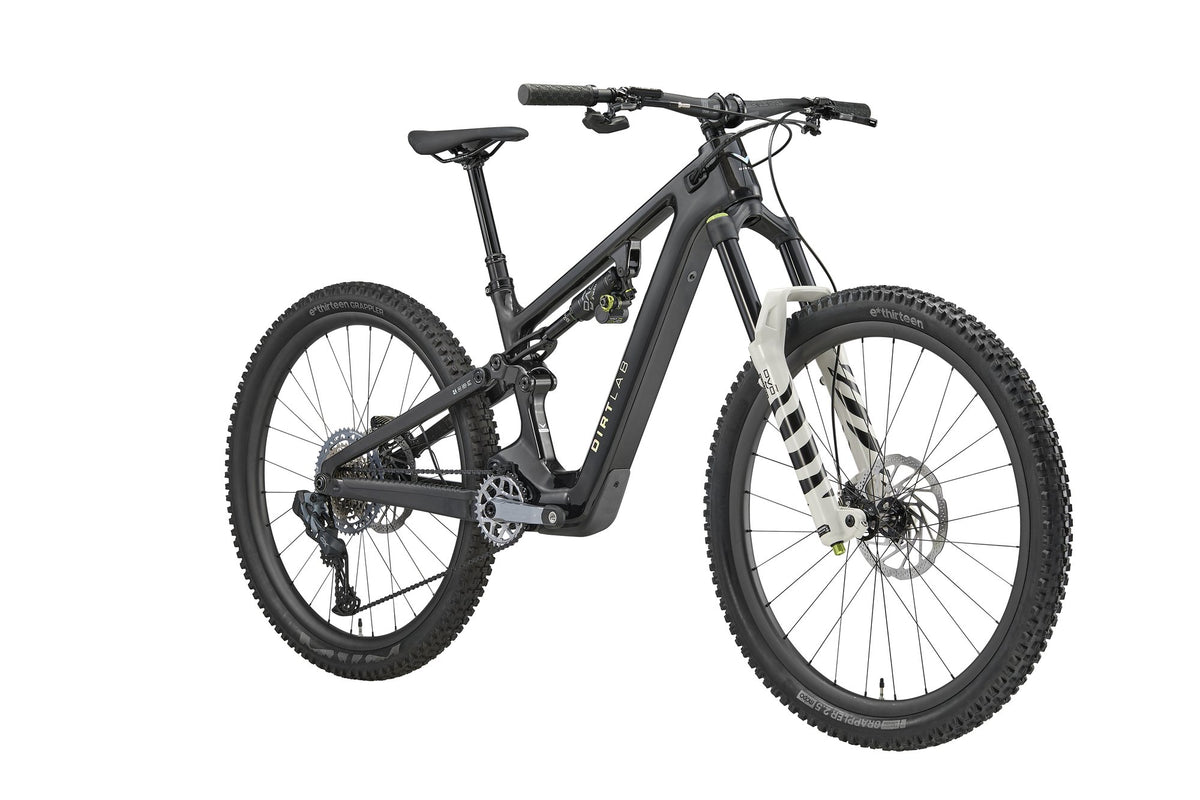
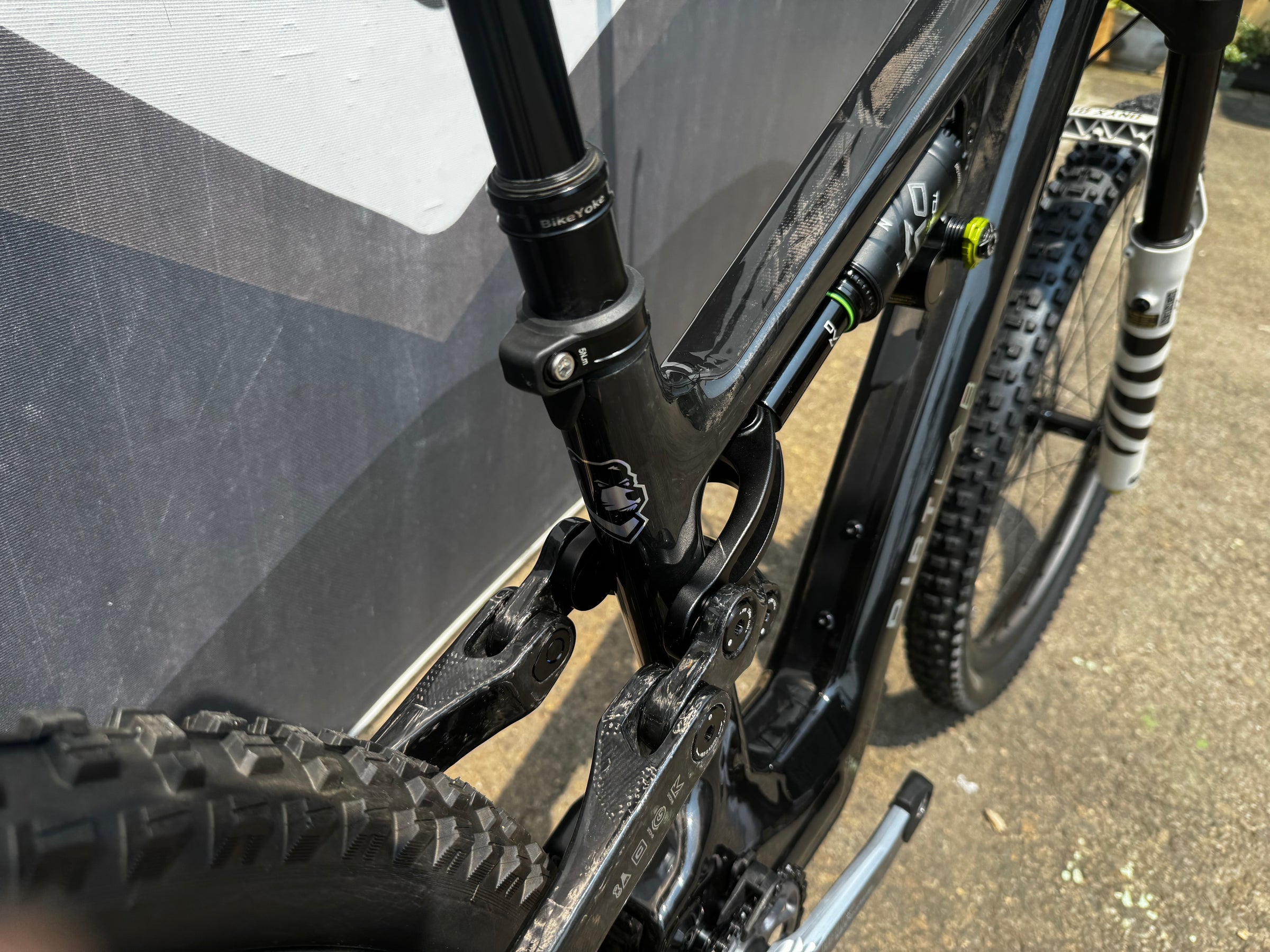
CP Suspension Setup
The Concentric Pivot (CP) suspension platform on the Paratu CP and Iuhu CP supports rear travel settings of 145mm, 150mm, 160mm, and 165mm, adjusted via shock stroke. Anti-rise is 49.1% across all travel settings. Recommended setup starting points: sag 25–28%, rebound at manufacturer base setting, compression open for trail riding.
CP Suspension Setup Calculator
Per-rider, per-shock, per-fork pressure / spring rate / damping clicks for the Paratu CP and Iuhu CP. Same CP platform.
Bike variant (build)
Rider weight (fully kitted)
85 kg
Shock model
Fork model
Riding style
Trail conditions
Shock — positive spacers/bands installed
Air-spring volume reducers. Default pre-filled from your weight + selected shock.
Shock — negative spacers/bands installed
Most air shocks: 1 negative volume spacer. DVO uses the same concept — same default count.
Fork — positive tokens installed
Most enduro forks ship with 0–4 tokens IN BOX; install progressively if you bottom too easily.
Fork — negative spring tweak (advanced)
Auto-balancing on most forks (leave 0). Manual override for DVO OTT (turns) / Manitou IRT (psi).
Shock PSI
—
Fork PSI
—
LSC / HSC
— / —
clicks from closed
LSR / HSR
— / —
clicks from closed
Spacers / tokens
—
Explore More Technology
K-VolveKinematics Overview
Anti-RiseBraking Stability
Anti-SquatPedaling Efficiency
Pedal KickbackKickback Relief
Leverage RatioSpring Rate Curve
Axle PathWheel Trajectory
Geo CalculatorInteractive Tool
Setup GuideSuspension Calculator
5-step setup procedure (CP-platform)
Riding zones — what the bike does at each compression depth
CP Platform · Suspension FAQ
Why the bike does what it does
Plain-English engineering answers to the questions riders, racers, and journalists actually ask about the CP platform. Independently corroborated by Phil at Bike Italia / MTBtech and by our own design team.
Why is the leverage ratio so flat? Doesn't every modern enduro frame need ~25-30% progression?
The shape of the LR curve is not what matters to the rider — its consequences are. A flat LR (~2% on the CP platform) gives you two first-order benefits:
- Uniform damping authority through the stroke. Damping authority at the wheel scales with LR^2. A 25%-progressive frame loses ~36% of its damping authority deep in the stroke (LR drops from 2.5 -> 2.0). On the CP, LR^2 varies by ~4-5% across the stroke. A click of LSC at 20mm does the same job as a click at 140mm — the adjustment behaves the way the rider expects.
- Thermal stability on long descents. Damper heat rate scales with shaft velocity squared. A flat LR bounds peak shaft velocity for a given wheel speed, so the shock runs cooler over a sustained 8-12 minute descent. Less oil shear, less viscosity drop, less damping fade.
If the LR is flat, where does the bottom-out resistance come from?
Three sources working together, not one:
- Slightly less than 30% sag (we target 28%) — leaves more spring travel in reserve.
- Progressive air spring with two positive and one negative volume spacer (DVO Topaz T3 reference tune).
- Hydraulic Bottom-Out (HBO) circuit active in the deep zone.
What is HBO and why does it matter for an enduro bike?
HBO (Hydraulic Bottom-Out) is a speed-sensitive circuit in the deep stroke of the damper. Unlike linkage progression or an elastomer bumper — both of which are position-sensitive — HBO knows the difference between a fast square-edge hit and a slow G-out, and responds differently to each.
On a slow 80%-travel compression, HBO does not engage hard — the bike feels plush through long compressions. On a fast square-edge at the same travel position, HBO ramps hard — exactly where the rider needs the protection. That behaviour is impossible to produce from linkage progression alone, because the linkage cannot tell the difference between fast and slow.
On the CP-platform setup we run, the HBO is one of three end-stroke tools (sag, air spring spacers, HBO) acting in concert. Race terrain produces a mix of fast and slow bottom-out events; HBO handles the mix better than passive bumpers.
On a slow 80%-travel compression, HBO does not engage hard — the bike feels plush through long compressions. On a fast square-edge at the same travel position, HBO ramps hard — exactly where the rider needs the protection. That behaviour is impossible to produce from linkage progression alone, because the linkage cannot tell the difference between fast and slow.
On the CP-platform setup we run, the HBO is one of three end-stroke tools (sag, air spring spacers, HBO) acting in concert. Race terrain produces a mix of fast and slow bottom-out events; HBO handles the mix better than passive bumpers.
Anti-squat at 97.3% — is that too low? Is the pedalling efficiency real?
The 97.3% figure is simulated at 34/28t with realistic rider weight — the gear and condition that reflects real climbing use. Some manufacturers quote anti-squat at standstill with optimistic gearing; that produces a higher headline number but is not what the rider experiences.
97.3% sits just below neutral at sag. Pedal input through the middle of the gearing range produces essentially no suspension compression. The bike climbs like a hardtail — no shock lock-out is needed on technical climbs. Phil's independent ASP analysis confirmed this figure at his measurement condition.
97.3% sits just below neutral at sag. Pedal input through the middle of the gearing range produces essentially no suspension compression. The bike climbs like a hardtail — no shock lock-out is needed on technical climbs. Phil's independent ASP analysis confirmed this figure at his measurement condition.
How is the CP platform's anti-rise tuned, and what does it feel like?
Anti-rise is 49.1% at sag (kinematic simulation) — tuned so the rear stays composed and predictable under hard braking, keeping the bike calm and planted when you need it most.
On a long technical descent — particularly braked sections into corners — the suspension stays active and the bike stays settled.
On a long technical descent — particularly braked sections into corners — the suspension stays active and the bike stays settled.
The axle path is forward — doesn't that make the bike harsh on square-edge hits compared to a high-pivot?
Yes — and we won't pretend otherwise. Forward axle path imposes a real harshness penalty on square-edge hits because the wheel has to decelerate against the direction of travel. A well-executed high-pivot will beat a forward-path frame on pure small-bump-to-mid-stroke smoothness over repeated rocks at speed. That's the one kinematic axis where high-pivots are honestly stronger.
Our answer is to quantify and contain the trade-off:
Our answer is to quantify and contain the trade-off:
- Forward excursion at bottom-out is approximately 8 mm — on the low end of forward-path frames, well below older Horst-link designs at ~12-15 mm.
- Low chain growth in the working zone (see chain-growth question) so the drivetrain doesn't add a second harshness source.
Pedal kickback — only 3-3.5 degrees? Some flow-trail riders prefer a livelier kickback feel.
Both observations are correct. Some kickback genuinely makes a bike feel alive under pumping on flow trails — perceived 'pop' on a pump track comes partly from the suspension resisting compression under pedal input.
The CP platform delivers support differently. PK at 3-3.5 deg is low but not zero, paired with 97.3% anti-squat. On flow terrain the bike feels firm under pedalling load because high anti-squat keeps the rear from sinking when you pump — the AS is doing the support work, not the kickback.
The felt difference: the CP platform is quieter through the drivetrain. Riders coming from bikes with 10deg+ kickback may read the quietness as 'less alive.' That's a feel preference; the right way to resolve it is on a test ride, not on the spec sheet. Phil's independent measurement confirmed PK at 3-3.5 deg, below the threshold most riders can perceive.
The CP platform delivers support differently. PK at 3-3.5 deg is low but not zero, paired with 97.3% anti-squat. On flow terrain the bike feels firm under pedalling load because high anti-squat keeps the rear from sinking when you pump — the AS is doing the support work, not the kickback.
The felt difference: the CP platform is quieter through the drivetrain. Riders coming from bikes with 10deg+ kickback may read the quietness as 'less alive.' That's a feel preference; the right way to resolve it is on a test ride, not on the spec sheet. Phil's independent measurement confirmed PK at 3-3.5 deg, below the threshold most riders can perceive.
I've ridden a very progressive VPP eBike that 'feels like less travel than its on-paper number' on rough terrain. Why?
Classic effect of pedal kickback and mid-stroke chain growth fighting the suspension through repeated hits. The rear triangle is trying to compress; the chain is trying to pull it back through its arc; the rider experiences that tension as the bike 'running out of travel' even though the on-paper travel is plentiful.
An idler eliminates this, at the cost of weight, drag, and a service interval penalty. The CP platform avoids it differently — by kinematic architecture (concentric pivot keeps the chain's effective pivot close to the chainring's rotational axis), so chain length change through the working zone is minimal, without an idler. Result: the CP feels closer to a high-pivot than to a typical VPP on rough chunder, but with simpler drivetrain and lower weight.
An idler eliminates this, at the cost of weight, drag, and a service interval penalty. The CP platform avoids it differently — by kinematic architecture (concentric pivot keeps the chain's effective pivot close to the chainring's rotational axis), so chain length change through the working zone is minimal, without an idler. Result: the CP feels closer to a high-pivot than to a typical VPP on rough chunder, but with simpler drivetrain and lower weight.
How much chain growth does the CP platform have in the working zone (sag to +80mm)?
Approximately 11 mm of chain growth from sag to +80 mm — the window where the rider lives most of the time, and where drivetrain-induced harshness is actually perceived.
Comparable VPP frames sit closer to ~12.5 mm in the same window. Idler-equipped high-pivot frames go lower, near zero, but with the trade-offs noted above.
Among non-idler enduro frames in this segment, the CP platform has the lowest chain growth in the working zone. That's a direct outcome of placing the main pivot concentric with the chainring area — the architecture's primary kinematic payoff lives exactly in the meaningful working window.
Comparable VPP frames sit closer to ~12.5 mm in the same window. Idler-equipped high-pivot frames go lower, near zero, but with the trade-offs noted above.
Among non-idler enduro frames in this segment, the CP platform has the lowest chain growth in the working zone. That's a direct outcome of placing the main pivot concentric with the chainring area — the architecture's primary kinematic payoff lives exactly in the meaningful working window.
Won't an air shock heat up and feel harsh after a 10-minute descent?
The intuition is universal in the rider community and it's about half right. Air cans do heat. But the air spring is not the dominant heat source on a rear shock.
Where the heat actually comes from on a 10-minute descent (~2,000 significant suspension cycles):
Why a coil swap doesn't fix it. A coil eliminates the ~9% air-spring contribution. But the damper architecture is identical — same shim stacks, same oil, same shear mechanism. Coil shocks also have an IFP gas chamber that heats. What riders actually feel from coil is lower static breakaway friction and a flatter spring rate as the shock warms — both genuine benefits. 'Coil runs cooler' is not.
Why the 230x65 mm shock on the CP platform is thermally excellent:
Where the heat actually comes from on a 10-minute descent (~2,000 significant suspension cycles):
- Air spring (adiabatic compression): ~2-5 J/cycle -> ~6 kJ total -> ~9% of the thermal budget.
- Damper (viscous shear): ~30 J/cycle -> ~60 kJ total -> ~91% of the thermal budget.
Why a coil swap doesn't fix it. A coil eliminates the ~9% air-spring contribution. But the damper architecture is identical — same shim stacks, same oil, same shear mechanism. Coil shocks also have an IFP gas chamber that heats. What riders actually feel from coil is lower static breakaway friction and a flatter spring rate as the shock warms — both genuine benefits. 'Coil runs cooler' is not.
Why the 230x65 mm shock on the CP platform is thermally excellent:
- Largest practical air volume in the segment -> compression ratio ~1.64 (vs 205x60mm shocks at ~1.90) -> ~25-35% cooler air spring per cycle.
- Flat LR bounds peak shaft velocity -> lower peak damper power dissipation than progressive-LR competitors.
- Longer shock body -> ~12% more aluminium mass and surface area than a 205mm shock -> more thermal capacity, better convective cooling.
How do hydraulic bottom-out, elastomer bumpers, and large air-can volumes compare?
All three approaches work — they solve the same problem with different tools:
- Hydraulic Bottom-Out (HBO): speed-sensitive, tunable by shim stack and port geometry. Used by DVO (Topaz T3), Fox (X2), Ohlins (TTX2 Air). Best match for race terrain because it discriminates fast vs slow bottom-out events.
- Elastomer bumper: passive, position-sensitive, tunable by swapping bumpers. Used by Formula (Mod). Simpler to service. Firmer than ideal on slow deep compressions; softer than ideal on fast deep hits.
- Hybrid HBO + bumper: used by EXT (Storia) and some custom tunes. More tuning surface; more parts.
Why don't you run an even lower leverage ratio?
Lower LR helps in several ways: lower shaft velocity for a given wheel speed, lower force on the shock at any given wheel force, finer authority on the damping adjusters, and reduced air-spring heating per unit wheel travel. We share that preference.
The CP platform sits at 2.51-2.57, which is toward the upper end of reasonable for a 165mm bike. To go lower (~2.3 band) we would need either a longer shock (we are already at 230mm; 250mm pushes out of standard sizing) or a different linkage geometry with its own set of compromises.
A future progressive linkage variant is being explored — targeting approximately 2.9 at sag dropping to 2.5 at end stroke. That raises starting LR a bit, but delivers a progressive curve some riders prefer, as a deliberate trade-off.
The CP platform sits at 2.51-2.57, which is toward the upper end of reasonable for a 165mm bike. To go lower (~2.3 band) we would need either a longer shock (we are already at 230mm; 250mm pushes out of standard sizing) or a different linkage geometry with its own set of compromises.
A future progressive linkage variant is being explored — targeting approximately 2.9 at sag dropping to 2.5 at end stroke. That raises starting LR a bit, but delivers a progressive curve some riders prefer, as a deliberate trade-off.
What is the eMTB pedal kickback advantage on the Maxon-equipped build?
Pedal kickback is the rearward rotation of the cranks when the suspension compresses. On a conventional pedal bike, the drivetrain has no active force opposing crank reversal — the full mechanical kickback angle is transmitted to the rider's feet.
With the Maxon BIKEDRIVE AIR S engaged, two effects reduce the felt kickback:
To our knowledge no other eMTB manufacturer has documented or marketed this effect. Independent technical journalism is welcome to verify.
With the Maxon BIKEDRIVE AIR S engaged, two effects reduce the felt kickback:
- Drivetrain stiffness under motor torque. The motor delivers continuous forward torque (90Nm peak). The cranks cannot freely reverse — they must overcome the motor's forward drive force first.
- Regenerative resistance during crank reversal. When the kickback force tries to drive the motor backward, back-EMF resists the reversal. Functionally, a mild regenerative braking effect — the motor absorbs the kickback impulse rather than transmitting it to the rider's feet.
- Eco: ~25-35% reduction -> ~2.0-2.5 deg felt
- Trail / Tour: ~40-50% reduction -> ~1.5-2.0 deg felt
- Boost / Sport: ~55-65% reduction -> ~1.0-1.5 deg felt
To our knowledge no other eMTB manufacturer has documented or marketed this effect. Independent technical journalism is welcome to verify.
What is the reference setup for an 85kg rider on the DVO Topaz T3?
215 psi main chamber / 180 psi piggyback, two positive plus one negative volume spacer, baseline damping per the tuning guide. This is the configuration that delivers the 3.08x wheel-force ratio and the thermal performance described above. For other rider weights, scale main pressure approximately linearly (see the per-shock pressure table in the calculator above), keep piggyback ~15-20% below main, and start from the recommended spacer count for your weight.
Are you considering boutique shocks like the Intend Rover or EXT Storia for the flagship spec?
Yes — both are under evaluation for the 2027 flagship. Reasons specific to the CP platform:
- Very large external air reservoir (Rover) directly addresses thermal load on multi-kilometre alpine descents — more gas volume = lower pressure rise per unit compression work = lower peak air temperature.
- Twin-tube damper architecture (Rover, Storia) separates compression and rebound oil paths more cleanly than a monotube, producing more consistent damping at high shaft velocities.
- Premium positioning consistent with where we want the flagship build to sit.
Have a question that isn't here?
Suspension is a system — your weight, terrain, riding style, and shock choice all interact. Email info@dirtlab.bike with your build and rider profile and the engineering team will reply with a tuned starting point.
Suspension is a system — your weight, terrain, riding style, and shock choice all interact. Email info@dirtlab.bike with your build and rider profile and the engineering team will reply with a tuned starting point.
Independent Analysis
See It in Action
Credit: Fil Palmer · MTBTech.it — independent kinematic analysis, 2024