


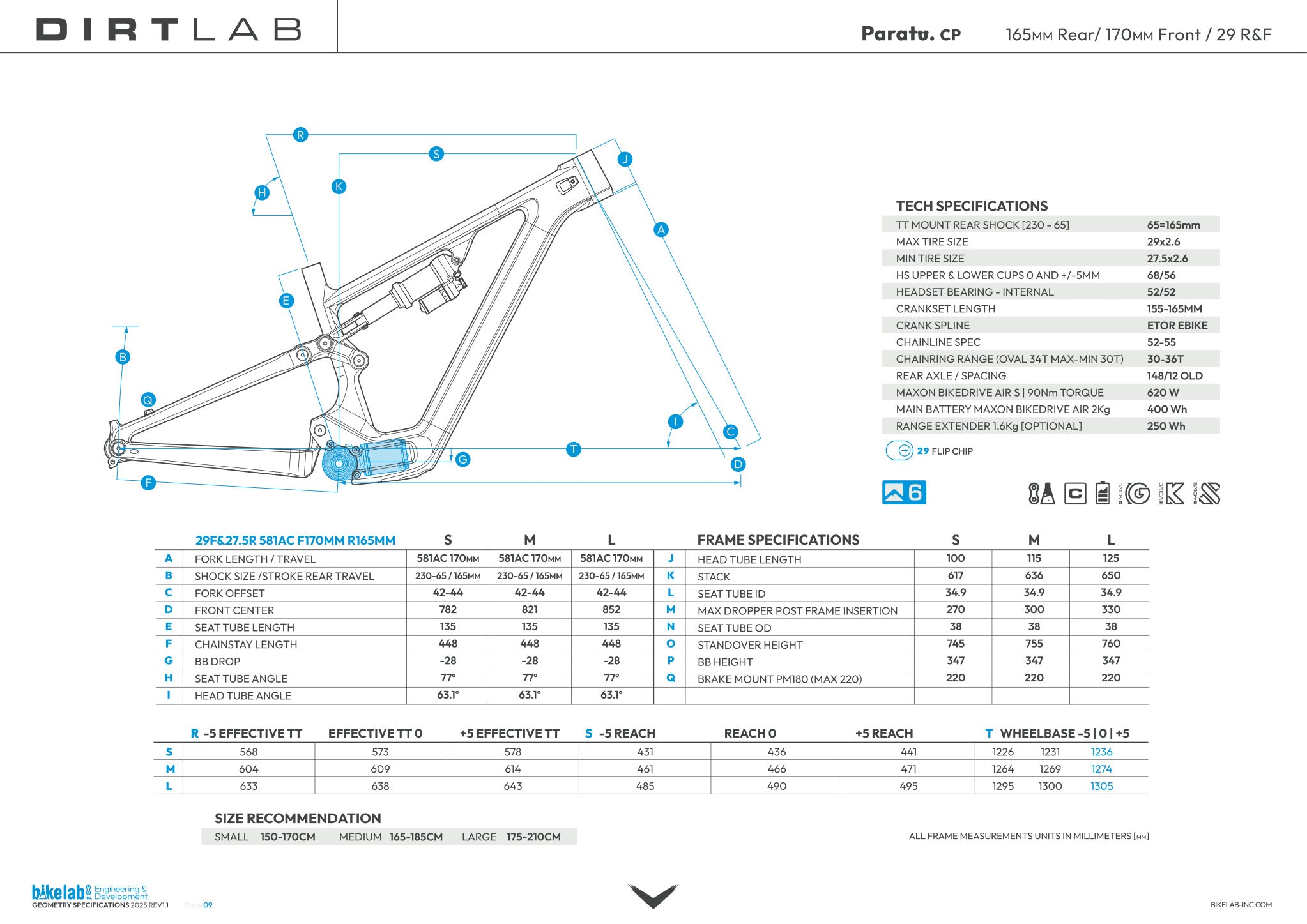
G-Volve Geometry — CP Platform
Geometry Evolution — how Dirtlab engineers frame dimensions for real-world trail performance.
G-Volve is Dirtlab's geometry philosophy. It is not a marketing term — it is a documented set of engineering decisions about head angle, seat tube angle, reach, stack, chainstay length, and bottom bracket height that define how every Dirtlab frame sits, handles, and responds under load. Every dimension is chosen for a reason and that reason is always trail performance.
What G-Volve Actually Means
Geometry on a mountain bike is not cosmetic. A one-degree change in head angle changes how the front wheel tracks at speed. A two-millimetre change in bottom bracket drop changes your pedal strike frequency on technical terrain. Reach determines whether your weight is in the right place when the trail pitches downhill. These relationships are not arbitrary — they follow physics, and G-Volve is the framework Dirtlab uses to make those decisions deliberately.
The name reflects a continuous process. G-Volve geometry is not static. Each generation of Dirtlab frames refines angles and dimensions based on rider feedback, changes in component standards, and developments in trail design. What does not change is the method: every dimension is calculated before it is cut into tube.
Core Geometry Principles
63° Head Angle
The Paratu CP and Iuhu CP run a 63-degree head angle — slack enough for high-speed stability on technical descents, not so slack that the bike becomes unresponsive at low speed or on tight switchbacks. Paired with a fork offset calculated to deliver the correct trail figure across all rider sizes.
77.8° Seat Tube Angle
A steep, near-vertical effective seat tube angle places the rider directly over the bottom bracket when climbing. This improves traction on steep ascents, reduces lower-back fatigue on long climbs, and keeps the front wheel loaded through technical uphill sections.
Reach-Based Sizing
Dirtlab sizes frames by reach — the horizontal distance from the bottom bracket to the top of the head tube. Reach is the most meaningful dimension for fit because it directly controls your riding position. Stack is matched to reach to maintain consistent bar height across sizes.
Chainstay Length
Chainstay length is set to balance rear-wheel traction against front-end agility. Shorter stays make the rear wheel more responsive; longer stays add stability at speed and improve traction on steep climbs. Dirtlab targets the optimal range with stays tuned per model.
Bottom Bracket Height
BB drop is set to keep the BB low enough for stability without creating pedal strikes on rock gardens. Mullet builds (29/27.5) require a separate BB height calculation — Dirtlab accounts for this via the flip-chip system so geometry remains consistent across wheel configurations.
RA Reach Adjust
Every Dirtlab frame is compatible with the RA Reach Adjust headset, which shifts the front axle path by ±5mm without changing head angle. A single frame size can cover a wider range of rider preferences — important for custom builds and for riders between sizes.
Geometry Reference — Paratu CP / Iuhu CP Platform (base: 160 mm fork, centered RA)
| Measurement | Value |
|---|---|
| Head Angle | 63.9° at 150 mm fork · 63.7° at 160 mm fork · 63.5° at 170 mm fork |
| Seat Tube Angle (effective) | 77.8° at 150 mm fork · 77.6° at 160 mm fork · 77.5° at 170 mm fork |
| BB Standard/Motor Mount | T47 89.5mm (pedal) / Maxon BD Air S (motor) |
| Wheel Options | 29" F&R or 29/27.5 mullet via flip chip |
| Sizes | S / M / L |
| RA Headset Adjustment | ±5mm reach |
Head Tube Length — A Deliberate Choice
Dirtlab head tubes are 10 mm taller than industry average for the same frame size. This is not an oversight — it is one of the most deliberate geometry decisions in the G-Volve system.
The reason is spacer stacking. When a head tube is too short, riders compensate by adding spacers under the stem to raise the bar height to a comfortable position. On many enduro bikes in the market, this results in 30 mm or more of spacer stack — a tall column of aluminium rings that adds compliance where you want rigidity, creates a longer lever arm that amplifies steering forces, and looks unfinished.
This matters for frame strength. Every millimetre of spacer between the headset and stem is a millimetre of unsupported steerer tube acting as a cantilever. More spacers mean a longer moment arm on the head tube junction — the single highest-stress zone on any front-triangle. Under hard braking, G-outs, and head-on impacts, this amplifies the bending load at the upper headset bearing. The result: more flex at the front end, less precise steering input, and accelerated fatigue at the steerer–stem interface. By building that height into the head tube itself, the load path stays inside the welded frame structure where wall thickness, butting profile, and heat treatment are engineered for exactly these forces. A taller head tube distributes the load across a longer bearing seat and more frame material — improving stiffness, fatigue life, and crash resilience compared to the same bar height achieved through spacer stacking.
It also matters for fit. A rider who needs 30 mm of spacers on another brand’s large frame may need zero spacers on a Dirtlab large. That is not because the bikes have different geometry — it is because Dirtlab’s head tube delivers the bar height directly, without the compromise of an extended spacer column.
Some reviewers have questioned whether taller head tubes raise the front end too high. The answer is in the numbers: Dirtlab’s stack heights are competitive with every bike in the segment. The difference is where the height lives — in the tube, not in spacers above it. The result is a stiffer, cleaner front end with the same bar position.
Why Geometry Matters More Than Components
Geometry is foundational. It is the one thing that cannot be upgraded after purchase. This is why Dirtlab invests engineering time in getting these numbers right before a single prototype is built, and why the geometry table is published in full for every model.
G-Volve and the S-Volve Sizing System
G-Volve geometry works in conjunction with S-Volve sizing — Dirtlab's approach to matching frame size to rider body dimensions. While G-Volve defines the angles and proportions of a frame, S-Volve defines which frame size fits which rider. Together they ensure that you are on a well-proportioned frame in the correct size.
Explore how geometry changes with travel, fork, and RA headset settings.
Open Geometry CalculatorFrequently Asked Questions
Why are Dirtlab head tubes taller than other brands?
Dirtlab head tubes are 10 mm taller than industry average to eliminate excessive spacer stacking under the stem. Most riders on competing frames need 30 mm or more of spacers to reach a comfortable bar height. With Dirtlab’s taller head tubes, the same bar position is achieved with 20 mm of spacers or less — resulting in a stiffer, stronger front end. The load path stays inside the welded frame structure where wall thickness, butting profile, and heat treatment are engineered for braking and impact forces. This improves frame stiffness, fatigue life, and crash resilience compared to spacer-stacked alternatives.
Does the taller head tube raise the front end too high?
No. Dirtlab stack heights are competitive with every enduro bike in the segment. The difference is that the stack height comes from the head tube itself rather than from spacers stacked on top. The bar height is the same — the structural path is better.
What is the 63-degree head angle based on?
The 63-degree head angle is calculated to provide high-speed stability on technical descents while maintaining responsiveness at low speed and on tight switchbacks. Combined with fork offset and trail figures, this angle delivers a steering character that is planted and predictable across all conditions.
How does geometry change between travel configurations?
Head angle and seat tube angle change slightly with different fork travel because the fork’s axle-to-crown stack height tilts the whole frame. At 170 mm fork, the head angle is approximately 63.5 degrees. At 150 mm fork, it steepens to approximately 63.9 degrees. All other dimensions — reach, chainstay, stack — remain constant.
See It in Action
Questions about geometry or sizing? We are happy to talk through it before you order.
Contact sales@bikelab-inc.com