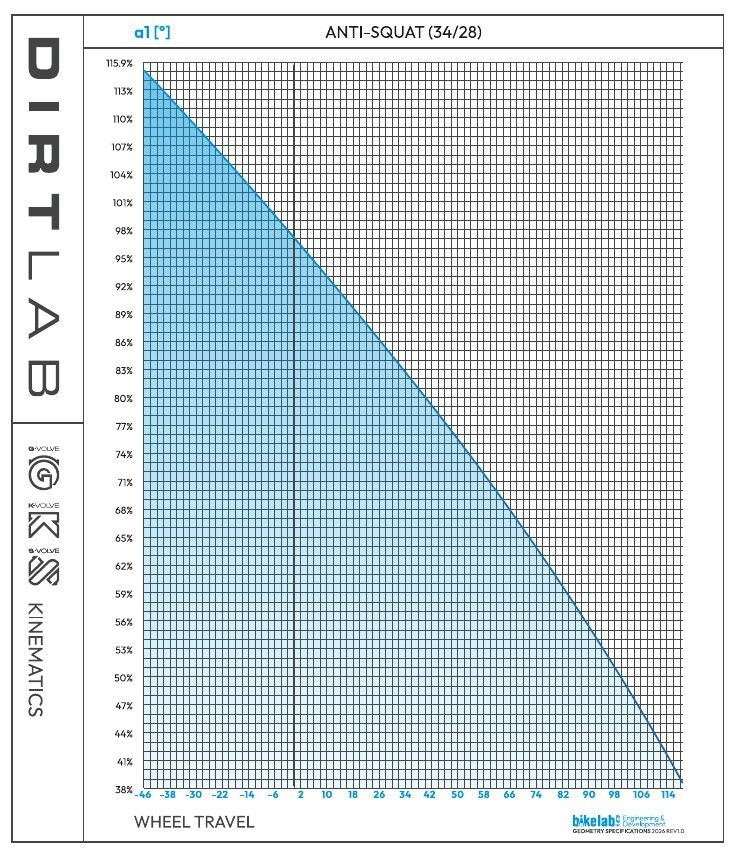
Anti-Squat — Pedalling Efficiency
Anti-squat describes how much a frame's suspension resists compression under pedalling forces. The Paratu CP and Iuhu CP Concentric Pivot geometry is tuned for consistent anti-squat across the gear range, minimising pedal bob without requiring a platform damper or lockout. This allows the suspension to remain active while climbing without sacrificing efficiency.
K-Volve Kinematics / Anti-Squat
K-Volve / Metric 02
Anti-Squat
97.3% at sag with 34/28t gearing, from our kinematic simulation of the CP layout. The geometry does the bob-control work — no lock-out needed, no compression damping fighting the chain. The bike climbs like a hardtail with active traction.
97.3%
At Sag
34/28t gearing — primary climbing gear
115%+
Small Cog
34/10t — high-speed pedalling
~72%
Large Cog
34/50t — granny gear climbing
38.7%
At Bottom
Steep decline through travel
The anti-squat curve is textbook-perfect — high enough to eliminate pedal bob without a lockout, but shaped so the suspension stays active over obstacles. You get the pedalling efficiency of a locked-out shock with the traction of a fully open one. This is extremely hard to achieve, especially on a motor-assisted platform.
— Fil Palmer, kinematic analyst & creator of @ebikeitalia6832
How Anti-Squat Works
Anti-squat describes how effectively chain tension counteracts suspension compression under pedalling load. At 100%, the chain force exactly cancels the squat force — the suspension neither compresses nor extends under pedal input. The Paratu CP sits at 97.3% at sag with 34/28t gearing: the geometry does the bob-control work that on other bikes must be done by compression damping.
This means compression damping does not need to fight geometry. LSC can stay at 2–3 clicks or even fully open. The geometry handles the anti-squat. This has a direct consequence for budget shock compatibility — the coarse compression circuit on a budget shock is never exercised in the regime where it fails.
The eMTB Advantage
Maxon Motor Protection
The Maxon BikeDrive Air S delivers up to 90Nm of continuous torque through the drivetrain. Without near-100% anti-squat, this torque would continuously compress the rear suspension. The 97.3% AS at sag means the motor drives the bike forward, not into its own travel. The concentric pivot — positioned at the motor/BB axis — is specifically designed to maintain high AS across the eMTB gearing range.
Anti-Squat Through Travel
The AS curve declines steeply from 97.3% at sag to 38.7% at full compression. This is by design:
Zone 1: 0–76mm (Climbing Zone)
AS stays above 65%. Chain tension nearly balances squat force. The suspension absorbs every small input while the drivetrain feels rigid. The bike climbs like a hardtail with active traction.
Zone 2: 76–165mm (Descending Zone)
AS drops from 65% to 38.7%. The chain no longer balances the squat force — the suspension opens fully for impact absorption. The rider isn't pedalling in this zone, so low AS is correct. The bike transforms from climbing machine to impact absorber.
Gearing Effect on Anti-Squat
The bike self-adjusts: harder gears (where more power is applied) produce higher anti-squat. This is a consequence of the concentric pivot placement.
Competitor Comparison
Frequently Asked Questions
What does 97.3% anti-squat mean in practice?
At sag with 34/28t gearing, the chain tension almost exactly cancels the gravitational compression force on the shock. The bike climbs like a hardtail — no shock lock-out needed on technical climbs. The remaining 2.7% means the suspension stays microscopically active rather than fully locked, preserving traction.
How does gearing affect anti-squat?
Anti-squat is gearing-dependent. At 34/50t (largest cassette cog), AS drops to approximately 72%. At 34/10t (smallest cog), it rises above 115%. The 97.3% figure at 34/28t represents the gear most used during sustained climbing. In practice, the bike self-adjusts: harder gears (where you push more power) have higher AS.
Why is high anti-squat important for an eMTB?
A Maxon BikeDrive Air S delivers up to 90Nm of continuous torque. Without near-100% anti-squat, that motor torque would compress the rear suspension on every pedal stroke. High AS means the motor drives the bike forward, not into its own suspension. No compression damping needed to fight motor-induced bob.
How does the Paratu CP compare to other eMTBs on anti-squat?
Most competitors sit at 85–100% AS at sag. The 6-bar linkage (160mm eMTB) matches at ~100%. The VPP (160mm) sits at ~92%. The 4-bar Horst (170mm) at ~96%. The Paratu CP's 97.3% is calibrated rather than maximised — just below neutral to keep the suspension microscopically active while eliminating perceptible bob.
Validated by