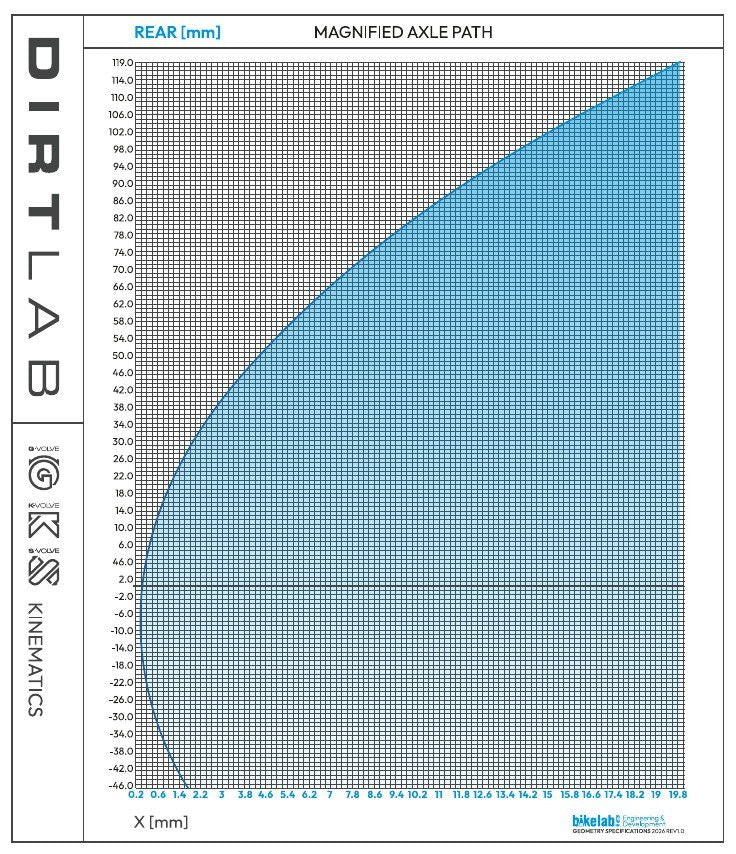
Axle Path — Paratu CP
The Paratu CP and Iuhu CP feature a rearward-sweeping axle path through the initial stroke, transitioning to a near-vertical path through mid-travel. The rearward component improves small-bump compliance at trail speed and prevents the rear wheel from dropping into square-edged holes. The path is determined purely by the Concentric Pivot linkage geometry and is consistent across all available travel settings (145 / 150 / 160 / 165mm rear).
K-Volve Kinematics / Axle Path
K-Volve / Metric 04
Axle Path
Two-phase intelligence: near-vertical initial stroke for precision, progressive forward sweep for impact management. 19.94mm total forward displacement with just 1.65mm in the working zone.
19.94mm
Total Forward
Full compression displacement
1.65mm
Working Zone
Forward movement sag ? +30mm
95°→72°
Path Angle
Linear decline through travel
2 Phase
Intelligence
Near-vertical initial, forward sweep deep
The axle path on the CP platform traces a rearward arc through the initial stroke - the wheel moves up and back rather than into the obstacle. This creates that effortless rollover characteristic. Combined with the near-zero pedal kickback, you get a rear end that absorbs terrain without any chain interference.
- Fil Palmer, kinematic analyst & creator of @ebikeitalia6832
Two-Phase Axle Path Architecture
The Paratu CP's axle path follows a two-phase design: near-vertical in the initial stroke for climbing efficiency, then progressively forward-sweeping in deep compression for obstacle management. The path angle transitions linearly from 95° at full extension to 72° at full compression, with a total forward displacement of 19.94mm.
Phase 1: 0-76mm (Initial Stroke)
Forward displacement: just 1.65mm over 30mm of wheel compression from sag. The path is within ±2° of vertical. Braking bumps, roots, and small rocks - the terrain in this zone - create forces that are predominantly vertical. A near-vertical path means the wheel moves straight up and over, with no lateral kick in either direction. Superior to both a rearward path (which kicks the wheel backward on braking bumps, breaking line) and a strongly forward path (which creates chain tension).
Phase 2: 76-165mm (Deep Compression)
Forward displacement accelerates from 1.65mm to 19.94mm. At impact speeds in this zone (major rock strikes, drops, roots at speed), the forward arc means the wheel rolls over the obstacle rather than deflecting from it. The progressive increase in forward angle changes the effective mechanical advantage against the shock, adding a geometric resistance component that combines with air spring progression and HBO.
Chain Growth Analysis
The Paratu CP has 15.93mm of total chain growth and 8.14° of pedal kickback at 34/28t. Despite the chain growth figure, the drivetrain-induced harshness in the working zone is minimal:
Working Zone Chain Growth: ~11mm
Full-travel chain growth (15.93mm, kinematic simulation) is the marketing figure. The rider-felt metric is chain growth from sag to +80mm - the repeated-hit zone where harshness is perceived. The Paratu CP's ~11mm in this window is the lowest of any non-idler frame in the segment. Idler-equipped pedal bikes can achieve lower values but at the cost of 2-3W continuous drivetrain drag and significant weight penalty.
Working Zone Chain Growth Comparison
Working zone (sag ? +80mm) is the rider-felt metric. Full-travel chain growth is the marketing figure but not where harshness is perceived.
Axle Path Competitor Comparison
Frequently Asked Questions
Is forward axle path actually better than rearward?
Forward axle path is correct for this bike's use case, not universally superior. A rearward path absorbs horizontal impact forces better - the wheel deflects away from obstacles. For DH at 60kph hitting a rock face, rearward is better. For eMTB enduro at 20-50kph on technical terrain, the near-vertical initial stroke and progressive forward sweep is the correct answer for balanced climbing efficiency and descending capability.
How much forward displacement does the Paratu CP have?
Total forward displacement at full compression is 19.94mm. But in the working zone (0-76mm from sag), forward displacement is just 1.65mm over 30mm of wheel compression. The path is within ±2° of vertical in this zone. The forward sweep accelerates only in the deep compression zone (76-165mm) where large impacts occur.
What is the axle path angle?
The path angle transitions linearly from 95° at full extension (near-vertical) to 72° at full compression (progressive forward sweep). This linear decline means there are no abrupt transitions - the bike's character transforms smoothly from climbing efficiency to impact management.
How does the Paratu CP compare to a high-pivot bike on rough terrain?
On pure small-bump-to-mid-stroke smoothness over repeated rocks at speed, a high-pivot design will be smoother. The Paratu CP compensates with low chain growth in the working zone (~11mm sag to +80mm, kinematic simulation). The trade-off is weight (~18kg vs ~22kg), drivetrain simplicity, and no idler maintenance.
Validated by