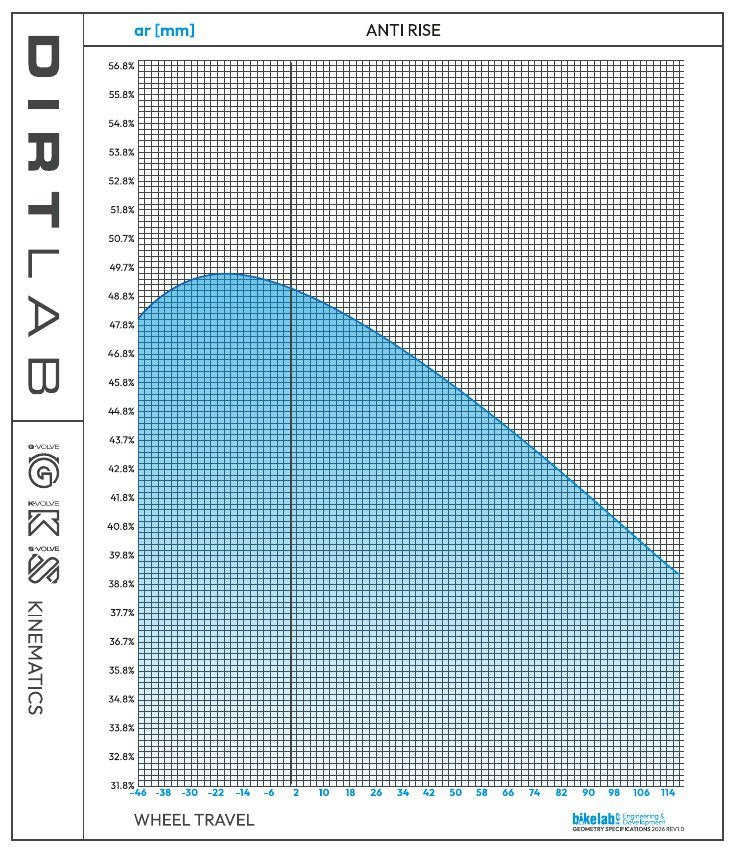
Anti-Rise — Braking Stability
The Paratu CP and Iuhu CP suspension platforms use a 49.1% anti-rise geometry. Anti-rise measures how much the rear suspension resists compression forces generated by braking. At 49.1%, the Concentric Pivot design substantially decouples braking from suspension movement, giving consistent tracking on steep descents without the rear wheel packing up under hard braking. This figure is derived from the Concentric Pivot (CP) linkage geometry and is fixed — it does not change with travel adjustment or rider weight.
K-Volve Kinematics / Anti-Rise
K-Volve / Metric 03
Anti-Rise
49.1% at sag, from our kinematic simulation of the CP layout — tuned so the rear stays composed and predictable under hard braking, keeping the bike calm and planted when you need it most.
49.1%
At Sag
Composed, predictable braking (simulated)
49.7%
Peak Value
Near sag — declining smoothly
38.8%
At Bottom
Smooth monotonic decline
~50pt
Lead
vs. typical enduro bikes
Braking Stability Explained
Anti-rise measures how the rear suspension responds to braking forces. At 100%, the rear end stays perfectly neutral under braking — no extension, no compression, no attitude change. The chassis stays level, the rider stays centred, and weight transfer happens through the tyres rather than through suspension geometry changes.
The Paratu CP's anti-rise curve (kinematic simulation) peaks at 49.7% near sag and declines smoothly to 38.8% at full compression. This declining profile means the bike is most stable exactly where stability matters most — in the normal riding position under hard braking.
Why This Matters on Trail
Steep Technical Descents
The Paratu CP runs 49.1% anti-rise at sag (kinematic simulation) — tuned so the rear stays composed and predictable under hard braking, while the suspension stays active to absorb terrain in the steepest chutes.
Braked Corners
Corner entry under braking is where most enduro time is lost or gained. Low AR bikes change their geometry as the rider brakes into a corner — the front dives, the head angle steepens, and the wheelbase shortens. The Paratu CP maintains its geometry through the braking phase, giving the rider a stable, predictable platform for corner entry.
The Physics of Forward Axle Path + High Anti-Rise
Complementary Design
The Paratu CP has a forward axle path, which creates a small harshness penalty on square-edge hits compared to rearward-path designs. Low chain growth in the working zone (~11mm sag to +80mm, kinematic simulation) keeps drivetrain feedback low when the rear is driven hard into obstacles. The net result is a bike that absorbs terrain differently from a high-pivot design.
Competitor Comparison
Frequently Asked Questions
What does the CP platform's anti-rise tuning mean?
Anti-rise describes how braking forces interact with the rear suspension. The Paratu CP runs 49.1% at sag (kinematic simulation) — tuned so the rear stays composed and predictable under hard braking, giving a calm, planted platform through braked corners and steep chutes.
How does the Paratu CP compare on anti-rise?
The Paratu CP runs 49.1% anti-rise at sag (kinematic simulation) — tuned for composed, predictable braking rather than a maximised headline number.
K-Volve Kinematic Analysis
Fil Palmer (@ebikeitalia6832) — Independent kinematic analysis of the CP platform suspension design
Validated by